Empowering Parents: The Journey of Speech Therapy at Home
As a parent, you are your child's first and most influential teacher. When you notice your little one struggling to express their needs or falling behind their peers in communication, it's natural to feel a wave of concern. You might be wondering, "Am I doing enough?" or "How can I help them find their voice?" The good news is that speech therapy at home is one of the most effective ways to support language development. Research consistently shows that children learn best in their natural environment—the place where they feel safest and most loved.
Implementing speech therapy at home doesn't mean you need to turn your living room into a clinical office. Instead, it's about weaving intentional communication strategies into your daily routines. Whether you're doing laundry, eating breakfast, or playing on the floor, every moment is an opportunity for growth. In this guide, we will explore how you can become your child's best communication partner while keeping the process fun, low-stress, and deeply rewarding.
Why Home-Based Intervention is So Effective
Professional speech-language pathologists (SLPs) are incredible resources, but they only see your child for a fraction of the week. You, however, are there for the hundreds of "teachable moments" that happen every day. When you practice speech therapy at home, you provide the consistency and repetition that young brains need to map out new sounds and words. Furthermore, when therapy feels like play rather than work, children are much more likely to engage and take risks with their speech.
Setting the Stage: How to Start Speech Therapy at Home
Before diving into specific exercises, it's important to create an environment that encourages talking. If you're just starting out, remember to be patient with both your child and yourself. Progress isn't always linear, and that is perfectly okay.
1. Follow Your Child's Lead
The first rule of home-based speech therapy is to follow your child's interest. If they are obsessed with toy cars, don't try to force a book about farm animals. Get down on the floor, push the cars with them, and use simple language like "Go, car, go!" or "Red car stop." When children are genuinely interested in what they are doing, their brains are "unlocked" for learning.
2. Use the "One-Up" Rule
A simple yet powerful strategy for speech therapy at home is the "One-Up" rule. If your child is currently using single words (e.g., "Juice"), you respond with two words ("More juice" or "Apple juice"). If they use two words, you move to three. This provides a clear, achievable model for their next developmental step without overwhelming them.
3. Incorporate Digital Tools Wisely
In 2026, technology plays a supportive role in early childhood education. While screen time should always be balanced with physical play, high-quality apps can provide structured articulation practice. For example, the Tiny Talkers app is specifically designed to make speech therapy at home engaging for toddlers. With a built-in Pronunciation Coach and over 100 word categories, it turns speech practice into a game that kids actually want to play. You can find it on iOS and Android.
Daily Activities for Speech Therapy at Home
You don't need fancy equipment to see results. Some of the best tools for speech therapy at home are already in your kitchen or toy box. Here are several activities to try this week:
The "Silly Mirror" Game
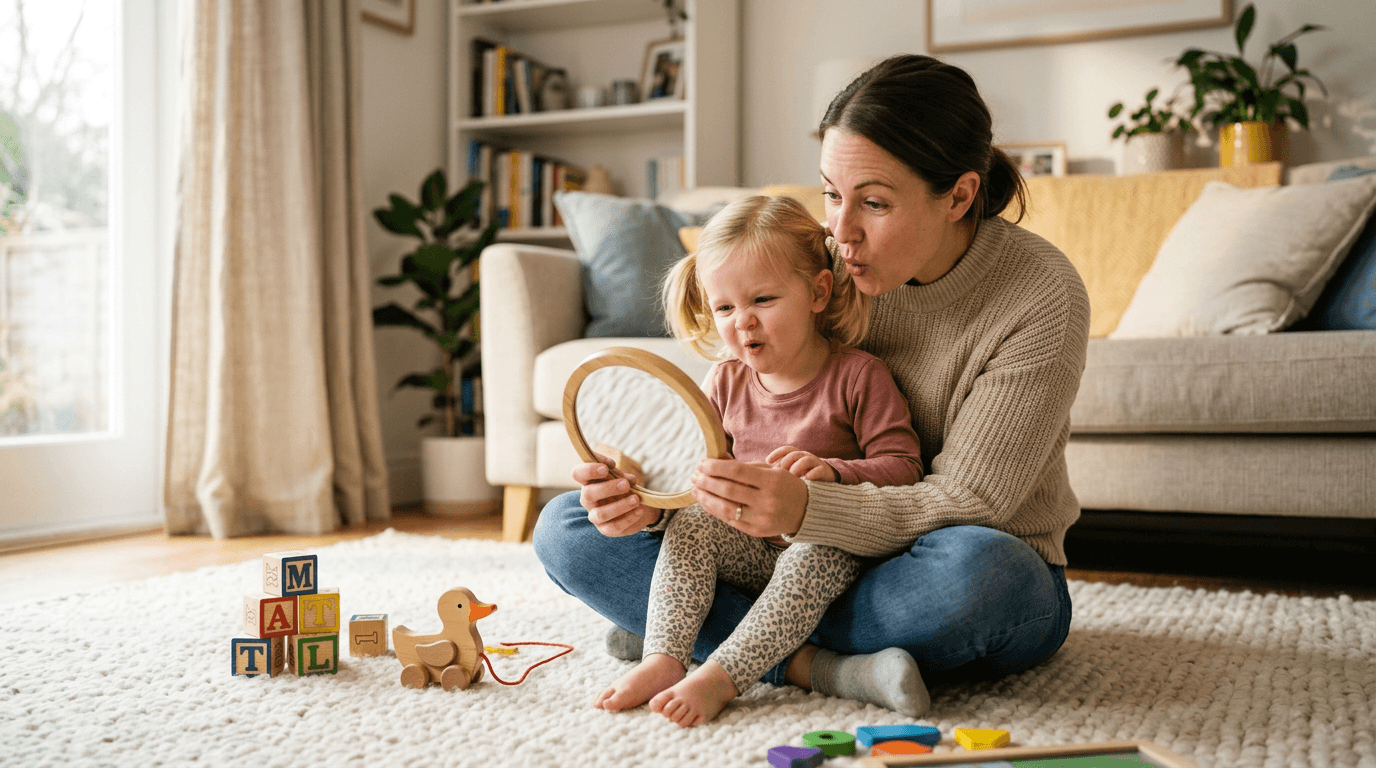
Articulation often depends on a child understanding how their mouth, tongue, and lips move. Stand in front of a mirror together and make silly faces. Stick out your tongues, puff out your cheeks, and practice blowing "raspberries." Then, transition into specific speech sounds. If your child is struggling with the "B" sound, exaggerate the way your lips press together and then "pop" open. This visual feedback is crucial for building motor pathways.
Sensory Bin Sound Hunts
Fill a bin with rice, beans, or kinetic sand. Hide small objects that start with a target sound (e.g., a spoon, a sock, and a star for the "S" sound). As your child digs through the bin, they can name each item they find. This tactile experience helps ground the learning process and keeps them focused on the task. For more ideas on sensory play, check out our article on Sensory Play and Language.
Narrating Your Life
This is often called "self-talk." Even if your child isn't responding yet, keep talking! Narrate what you are doing as you do it: "I am washing the blue plate. Now I am drying the plate. It is clean!" This constant exposure to vocabulary in context helps build their "receptive language"—their ability to understand what is being said—which is the foundation for "expressive language" (speaking).
Using Technology as a Supplement
While physical toys and face-to-face interaction are the gold standard, parents often need a break or a way to keep their child occupied during a car ride or waiting room visit. This is where a dedicated speech therapy app becomes invaluable. Tiny Talkers offers a safe, ad-free environment where children can work on articulation and vocabulary through alphabet games and custom stories.
The app's Pronunciation Coach provides instant feedback, helping your child hear the difference between sounds. It's a great way to reinforce the work you're doing during your dedicated speech therapy at home sessions. By combining traditional play with the structured activities in Tiny Talkers, you provide a well-rounded approach to learning.
Creating a Sustainable Schedule
One of the biggest hurdles parents face is finding the time. The secret to successful speech therapy at home isn't an hour-long session; it's "sprinkling" therapy throughout the day. Aim for 10-15 minutes of dedicated play twice a day, plus the incidental learning that happens during meals and bath time.
- Morning: 5 minutes of "Choice Making" (e.g., "Do you want the blue shirt or the red shirt?").
- Afternoon: 15 minutes of floor play or using the Tiny Talkers app for articulation practice.
- Evening: 10 minutes of reading books, focusing on pointing at pictures and naming objects.
Note: Always consult a speech-language pathologist for professional advice and to ensure your home routine aligns with your child's specific needs.
When to Seek Professional Help
While practicing speech therapy at home is incredibly beneficial, it is not a replacement for professional intervention if a child has a significant delay or a physical condition like a tongue-tie or hearing loss. If you notice any of the following "red flags," reach out to a certified SLP or your pediatrician:
- Your child is 18 months old and does not use at least 10 words.
- Your child is 2 years old and cannot follow simple directions.
- Your child seems frustrated when trying to communicate.
- You or other familiar adults have a hard time understanding more than half of what your child says by age three.
Integrating professional therapy with your own efforts at home creates a "wrap-around" support system that gives your child the best possible chance at success. For more information on what to expect during a professional evaluation, read our guide on Preparing for Your Child's First Speech Evaluation.
Conclusion: You Are Your Child's Hero
The journey of improving your child's communication can feel long and sometimes lonely, but you are not alone. By choosing to prioritize speech therapy at home, you are giving your child a gift that will last a lifetime. Every "mama," every "ball," and every correctly pronounced "S" is a victory worth celebrating.
Remember to keep it light, keep it fun, and don't be afraid to use all the tools at your disposal—from cardboard boxes to the Tiny Talkers app. You've got this, and Tiny Talkers is here to support you every step of the way. Download the app today on iOS or Android and start your next speech adventure together!